
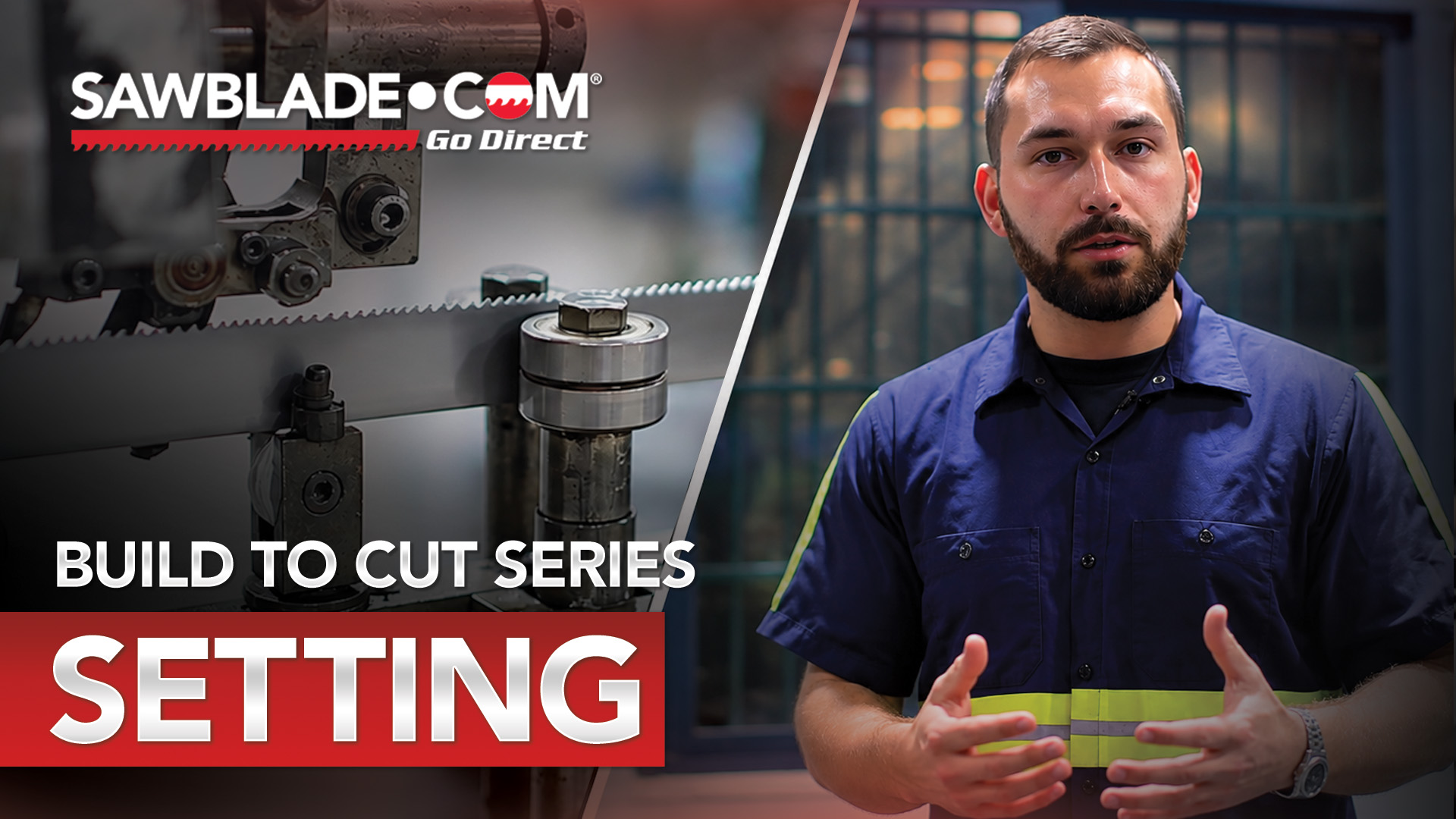
At Sawblade.com, every bandsaw blade goes through many steps before it reaches your saw. One of the most important is the setting process. Most people never think about it, but it has a big effect on how well your blade cuts and how long it lasts. Let us take you inside our high production facility to show you what setting is, why it matters, and how we check every single tooth.
What Is Blade Setting?
Setting is the step where we bend the teeth of the blade. Each tooth is pushed a small amount to the left or to the right. This gives the cutting edge a slight curve and makes the row of teeth wider than the body of the blade.
It sounds simple, but this small change is what lets a blade move freely through the material instead of getting stuck.
Why a Blade Needs Set
The main job of set is to reduce the pinch point.
Think about cutting a block of cheese with a knife. The knife has no set, so the cheese sticks to the sides of the blade as you push through. The same thing happens when you cut steel with a blade that has no set.
When the teeth are set, they cut a path (called the kerf) that is wider than the blade itself. That leaves a gap for the blade to run through.
What this means for you:
- Less pinching and binding in the cut
- Less rubbing on the sides of the blade
- Smoother, steadier cutting
Every Tooth Checked with AI and a Camera
Setting is one of the most closely checked steps in making a blade. As each tooth is set, we inspect it using AI and a photo camera. This lets us hold every single tooth to within a couple of thousandths of an inch.
Why does that matter? If one tooth sticks out more than the others, it does more of the work, wears out faster, and can pull the blade off line. Keeping every tooth inside a tight range gives you:
- A true and reliable blade
- Straighter, cleaner cuts
- Sawing that is fast and efficient
The Setting Step at a Glance
| What We Do | What It Does for You |
|---|---|
| Bend each tooth left and right | Opens a path wider than the blade |
| Reduce the pinch point | Blade does not bind in the cut |
| Check every tooth with AI and a camera | Catches any tooth out of place |
| Hold each tooth to a couple of thousandths | A true blade that cuts straight |
What Comes Next
Setting is only one part of the story. The next step is heat treating, which is really where the blade is made. After that, the blade goes through sandblasting. We will cover both in upcoming articles, so stay tuned.
Small Details, Big Results
A few thousandths of an inch may not sound like much, but it is the difference between a blade that fights you and one that cuts clean every time. That is why we check every tooth, on every blade.
Ready for a blade you can count on? Shop Sawblade.com. Made with care, built to cut.